
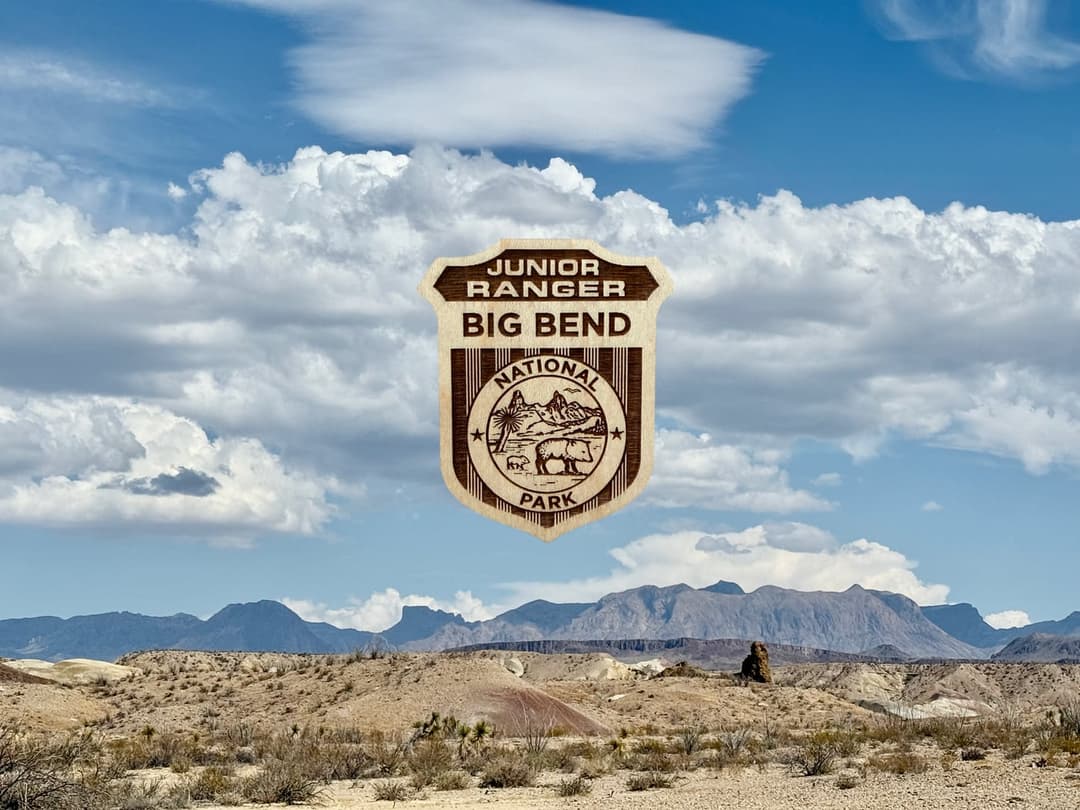
Big Bend National Park with Kids: Junior Ranger Guide
Big Bend National Park is named for the broad, sweeping bend of the Rio Grande as it makes a pronounced turn along the Texas–Mexico border — fossil-and-volcano country where the Chihuahuan Desert meets the sky-island Chisos Mountains and a river that draws its own line.
This was the first National Park we ever visited together, before we were married, with our first baby and a head full of more plans than we knew what to do with. That was a different couple, a different life — long before van life, long before we had lived out West, before Rogue Valley and Tahoe and Shasta-Trinity and the Pacific Northwest taught us how a body settles into a forest. Two decades later we drove back in, this time with two daughters, a sprinter van, and 150 National Parks under our belt. The same park. A wholly different family.
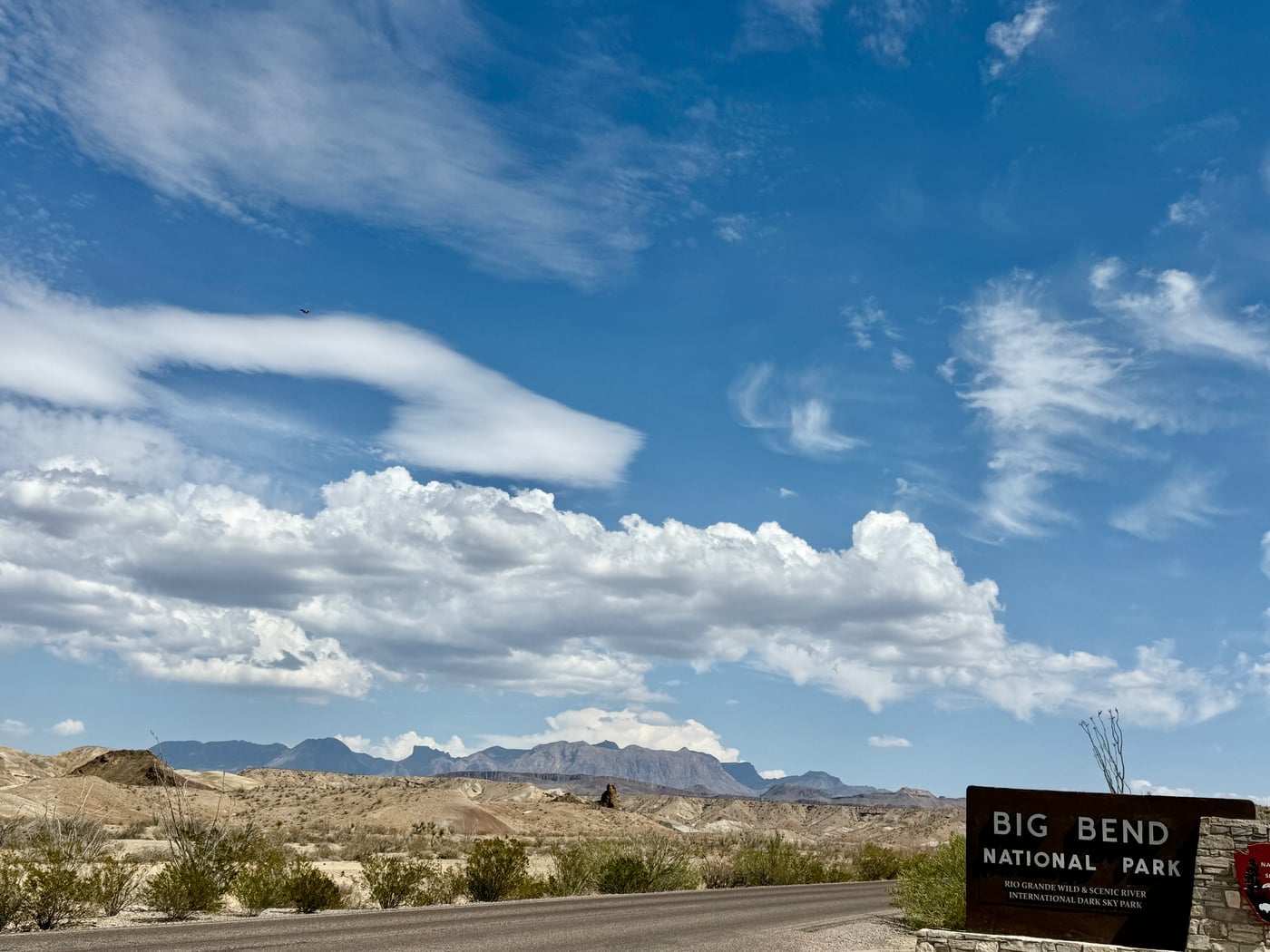 Entering Big Bend — the Chisos Ridgeline Against the Texas Sky
A Sky Island in the Desert
We rolled in from Guadalupe Mountains and Fort Davis, the Chihuahuan Desert stretching long and pale until the Chisos suddenly stand up in front of you — a sky island, an entire little mountain world cooler and greener than the desert it sits in. The girls pressed against the windows.
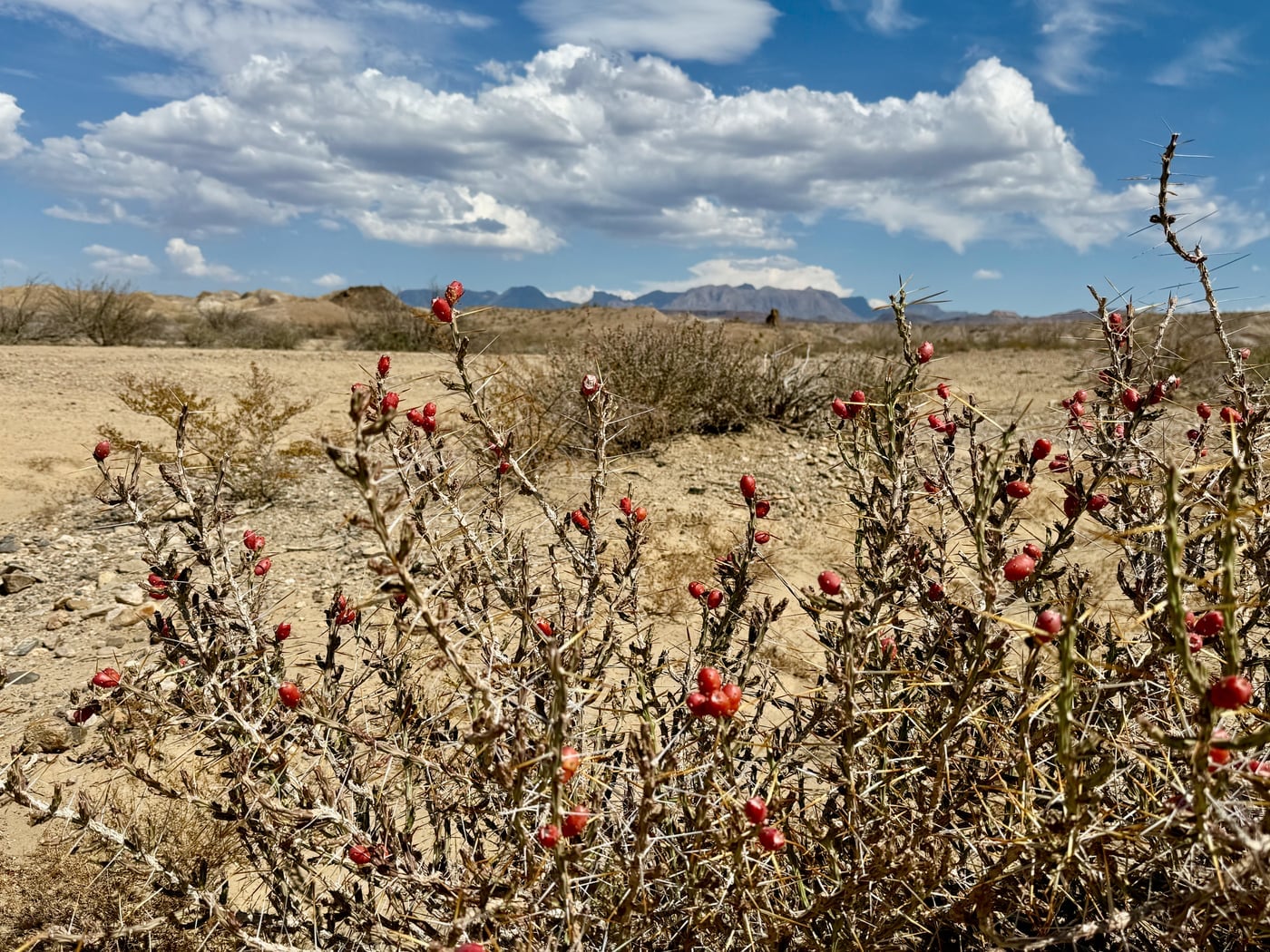 Ocotillo and the Chisos — a Sky Island Rising out of the Desert
We planted ourselves in the Chisos Basin. It's the only stretch of the park with high elevation and cooler air, a hidden mountain forest tucked into the desert with oak, juniper, pinyon pine, madrone, cypress, and even Douglas Fir holding on in the highest, shaded canyons. Coming from the heat of the basin floor, the climb up into the Chisos feels like opening a door into a different country.
The surprise of the trip was the double rainbow. It had not rained a drop in Big Bend since February and we were there in nearly April. That should have meant cracked earth and brittle grass. Instead a small desert storm rolled in over the basin, and that night a double rainbow lit up over our campsite — the kind of mother-nature welcome you cannot plan for and will never forget. Sprinterdad and I just looked at each other. Twenty years on, the park was still putting on its own kind of show.
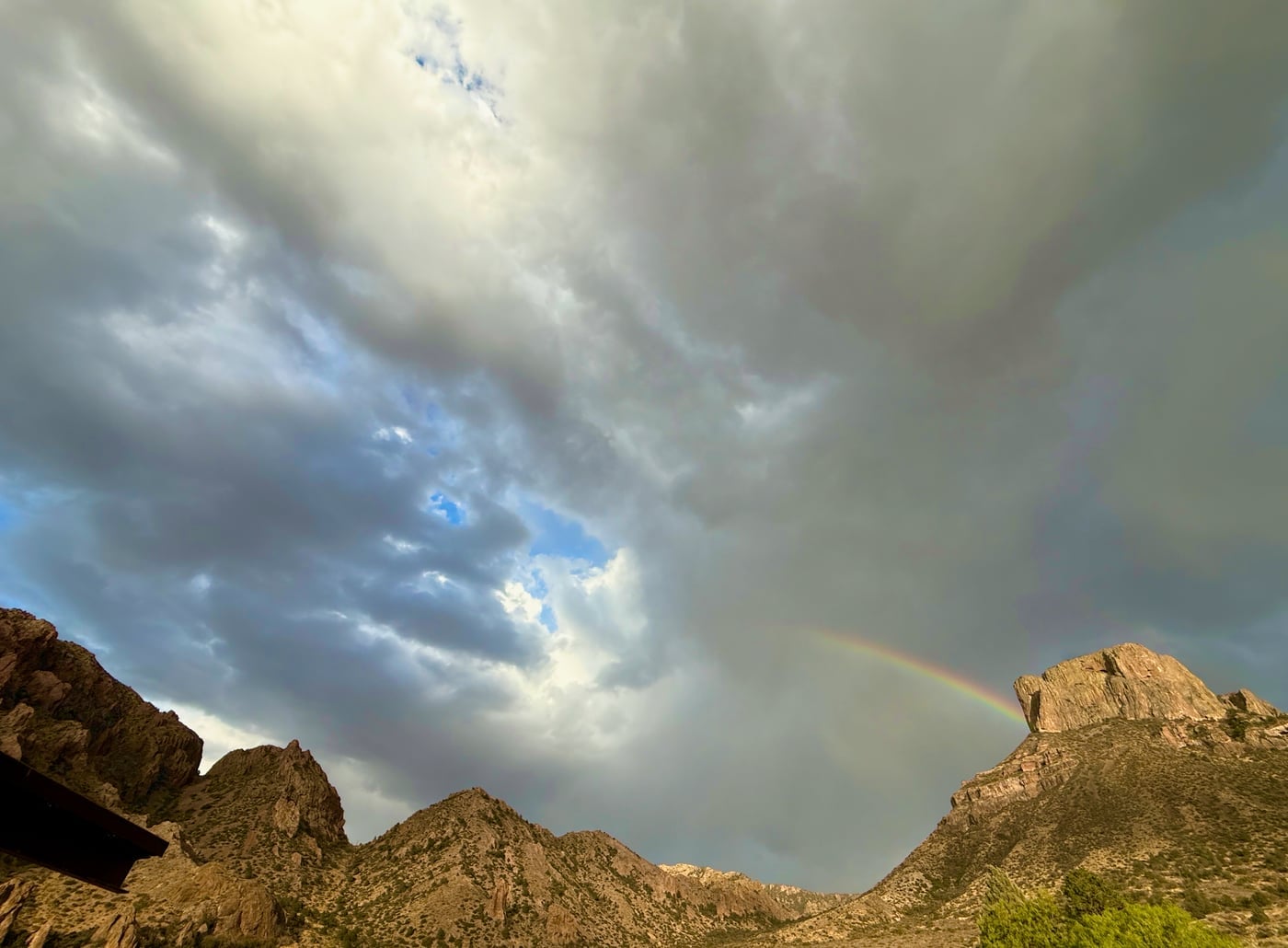 The Surprise — a Rare Desert Storm and a Rainbow Over the Chisos Basin Campground
The Window — Where the Mountain Pours
The Window hike is the one I remembered faintly from twenty years ago, coming back to it as a parent is something else entirely. The trail drops down through the basin and ends at a notch in the rock called the Window — a slot where the entire Chisos drainage funnels through and pours out toward the desert below. On a dry day, what you see is a polished stone chute and a thousand-foot view. What I could not stop imagining was what this place becomes in a flash flood — water coming down off the basin, narrowing into this single throat, throwing itself off the edge as a massive waterfall. The rock at your feet is so smooth (and slippery) it is nearly mirrored. Powerful water polished it that smooth.
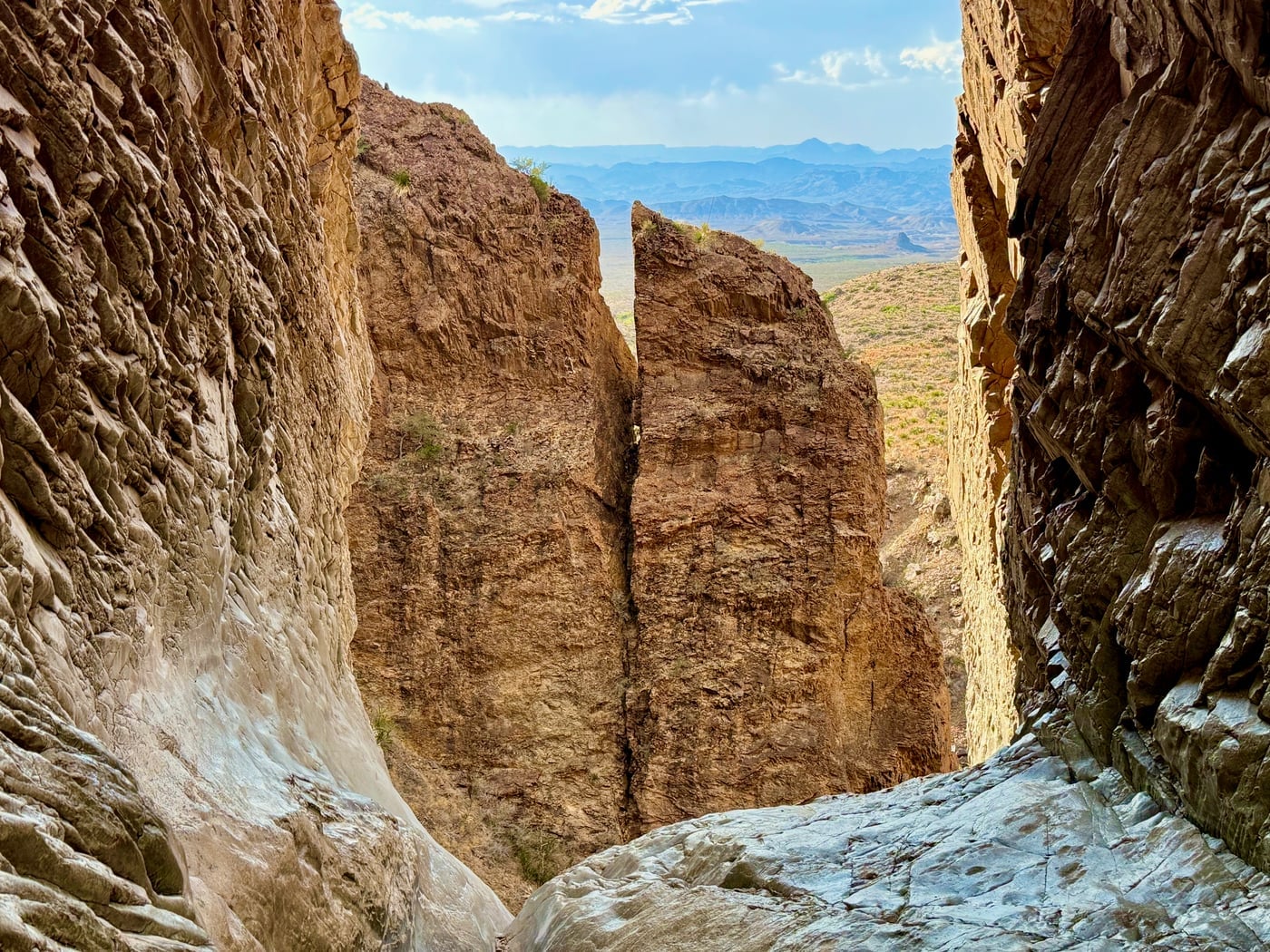 The Window — Where the Whole Chisos Drainage Funnels into the Desert
The girls felt it. They got quiet in that good way — not scared exactly, but humble. We guessed the waterfall would be well over a thousand feet. We imagined it was only several times a year that the mountain puts on a powerful spectacle of rapid, torrential downflow thundering into the canyon below.
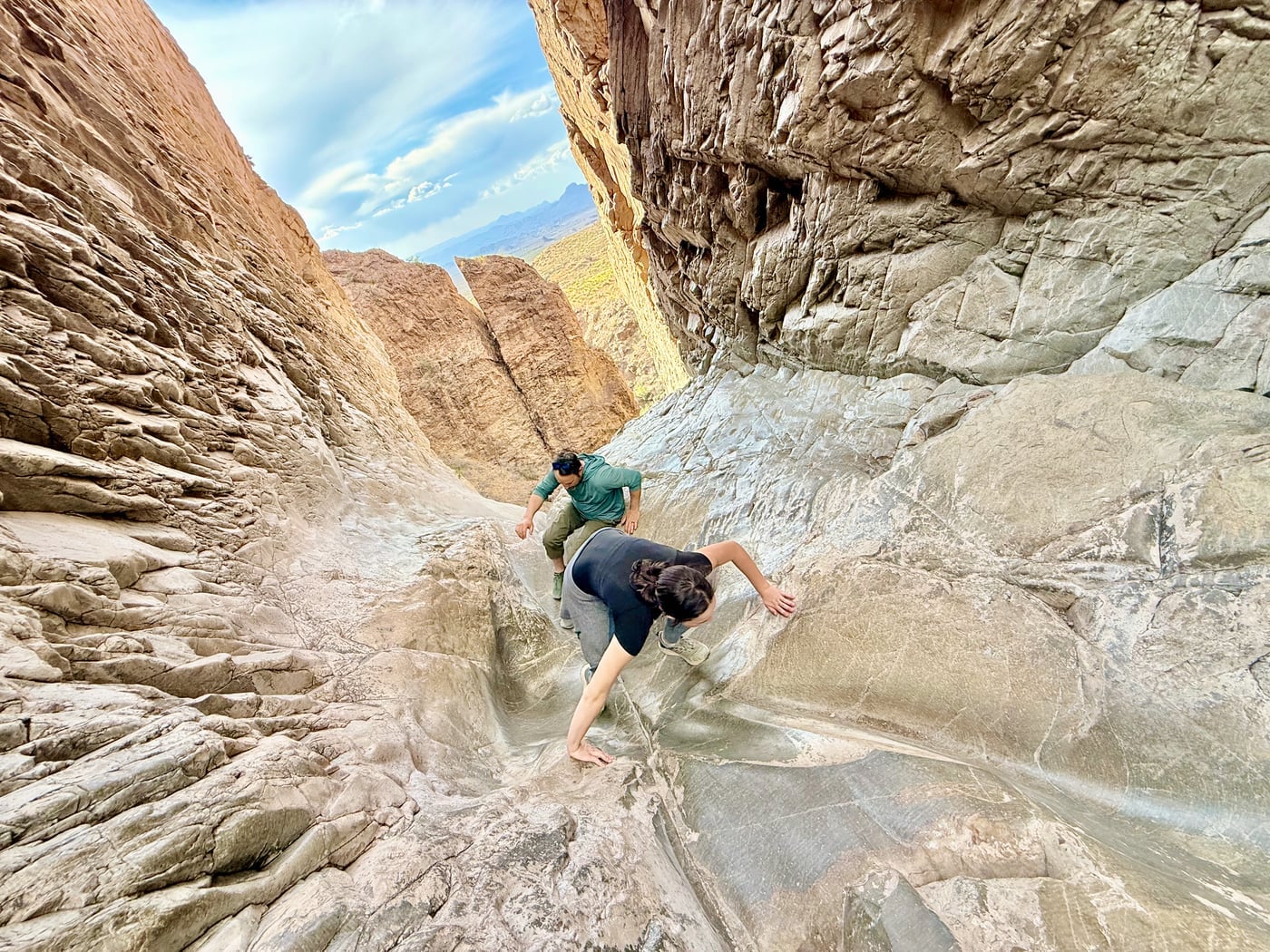 Polished Stone at the Window — Mirror-Smooth from Centuries of Flash Floods
Big Bend keeps reminding you that mother nature is the architect here. Rugged Chisos. The carved path of the Rio Grande. Barren desert with delicate life threaded through it — all the archetypes of a life laid out across one park. The impossible feats. The smooth sailing. The almost-unsurvivable moments. Somehow it all comes together and tells a story, the way our own lives do if we're paying close enough attention.
Junior Ranger at Big Bend
The Junior Ranger program at Big Bend — full program details on our Big Bend park guide — is one of the more substantial booklets in the system, and the girls loved it.
It opens with a serious safety review on the two big neighbors here: black bears and mountain lions, both at home in the Chisos. Then it moves into the practical part — what desert plants make what household products. The prolific prickly pear makes jellies and treats. The candelilla makes candles. The ocotillo makes a natural living fence. The lechuguilla makes soaps. (Mescal agave makes tequila, but we left that page for Sprinterdad.) By the time the girls finished those pages, every plant outside the visitor center had a job.
The booklet then teaches the Chihuahuan Desert ecosystem — how the plants and animals here have adapted to a climate that does not forgive — and finishes with the geology that built this place: faults that cracked the crust, volcanic dikes that pushed up through it, and erosion that has been carving on the result for millions of years. There are hiking challenges that earn extra patches if you want to commit a few more days; we passed on those this time so the girls could fully take in the campsite, the rare double rainbow, and the night ranger program on the soundscapes of Big Bend, listening to the desert in the dark, and naming what you hear.
The badges are beautiful. But what the girls carried out was bigger than the badge — the names of the plants, the shape of the mountains, and a quiet understanding of the delicate balance in this grand desert.
Van Life Tips for Big Bend
Where to camp: We stayed up in the Chisos Basin Campground, which is the cooler, greener, sky-island camping inside the park — small, no hookups, reservable through recreation.gov, and worth every effort. If the basin is full, the desert sites at Rio Grande Village and Cottonwood are good options at lower elevation. Outside the park, Stillwell Store and Maverick Ranch RV Park near Lajitas both work for bigger rigs.
Best time to visit: Late fall through early spring. We came in nearly April and that is right at the edge — past mid-April, the basin floor turns into a furnace. Summer in Big Bend is brutal. Spring rewards you with the chance, never the promise, of a desert bloom.
What to bring: More water than you think you need, real shoes for the polished rock at the Window, layers for the basin (it dropped 30 degrees on us at night), and binoculars. The night sky here is some of the darkest in the country.
Don't miss: The night ranger programs at the basin amphitheater. Big Bend is an International Dark Sky Park and the soundscapes program — listening to the desert at night and learning what you're hearing — is the kind of Junior Ranger moment our girls still talk about.
A practical save: Our van stove was out of commission for this entire trip (a recall, leaking gas — we had left home with a broken sink and stove and refused to let that stop the journey). What rescued us in Big Bend was the food truck parked at the Chisos Basin Visitor Center — a warm dinner the night of the rainbow, hot coffee in the morning, and a reminder that family travel is mostly about staying flexible with what is actually in front of you.
Entry: $30 per vehicle, good for seven days — or free with an America the Beautiful Annual Pass.
Where We Headed Next
We left Big Bend the way we came in twenty years ago — quiet. Some parks ask you to perform. Big Bend asks you to listen. The Rio Grande keeps drawing its line. The Chisos keep holding their cooler air above the desert. The Window keeps pouring whenever the storms come.
The girls are not the babies we first carried into this park. We are not the people we were then. But the park — the park is doing exactly what it was doing in 1858, in 1958, in 2006, and again now. That is the gift of these places. They outlast us, and they let us see ourselves a little more clearly each time we come back.
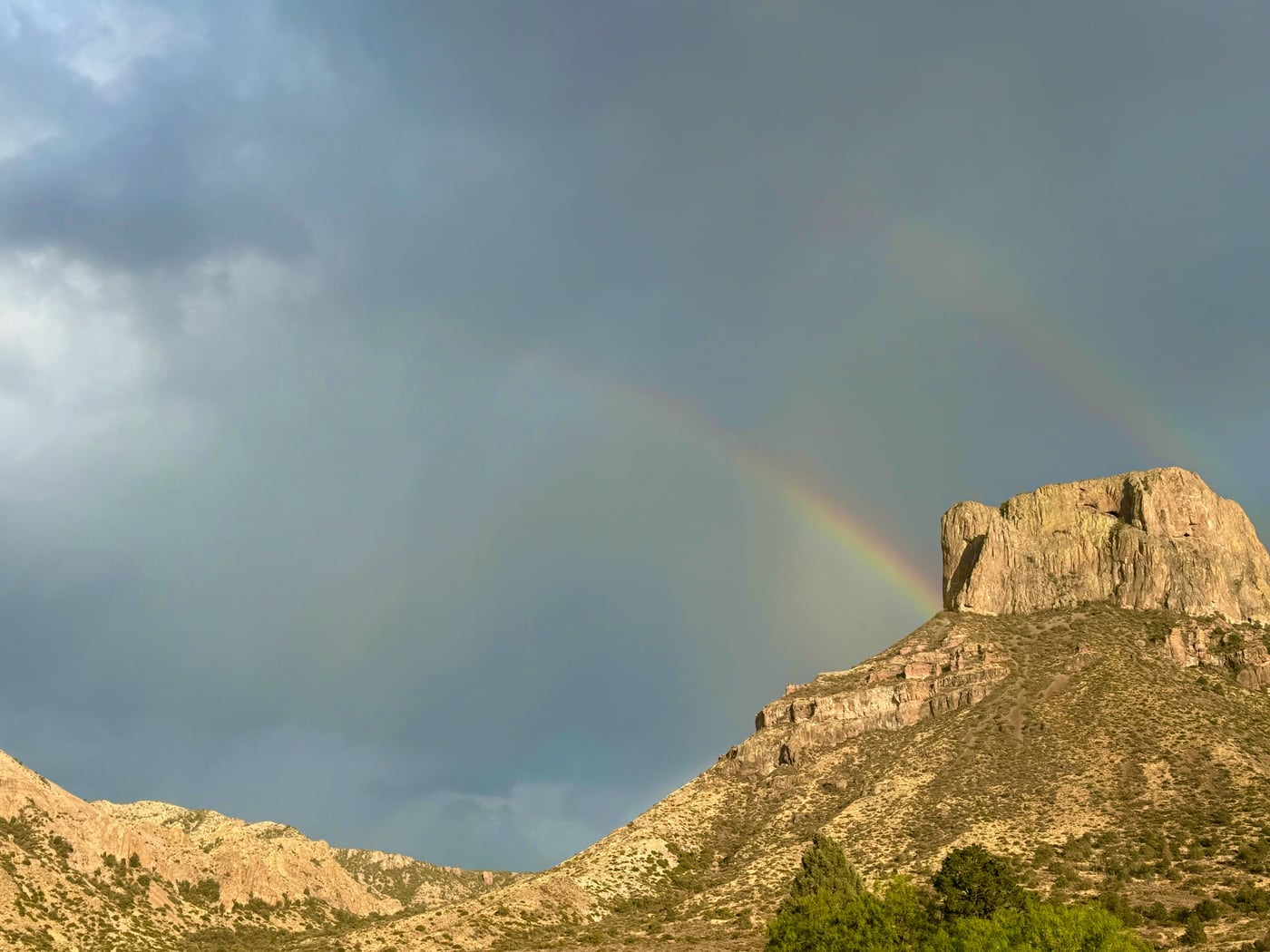 A Double Rainbow Over Big Bend — Twenty Years On, the Park Still Puts on Its Own Show
More from our Southwest van life journey — Guadalupe Mountains, Fort Davis, White Sands, Carlsbad, and El Malpais — coming soon.
Wondering how we make National Park trips affordable for the whole family? Read Affordable, Easy and Fun Family Vacations at our National Parks.
Parks Mentioned in This Post
Earn Junior Ranger badges at these parks — track your progress on our badge tracker
Continue the Journey
Guadalupe Mountains National Park with Kids: Junior Ranger Guide
Guadalupe Mountains National Park tells the story of a 260-million-year-old Permian Sea, a fossil reef now standing as the highest peaks in Texas — and the last stronghold of Mescalero Apache freedom. Here's how we visited with the girls and earned the Junior Ranger badge.
Fort Davis National Historic Site with Kids: Junior Ranger Guide
Fort Davis NHS is one of the best-preserved frontier military posts in the Southwest — where the legendary Buffalo Soldiers served after the Civil War. Here's how to visit with kids and earn a Junior Ranger badge in this overlooked West Texas gem.
More in National Parks & Places
Jul 14, 2026
Jul 4, 2026