
Pompeys Pillar with Kids: Junior Ranger Guide
Pompeys Pillar National Monument holds something pretty cool: the only on-site physical evidence of the Lewis and Clark Expedition still visible along the route they traveled. On July 25, 1806, homeward bound down the Yellowstone River, William Clark climbed this lone sandstone rock, looked out over a wild country, and carved his name and the date into the stone. More than two hundred years of Montana weather later, "W. Clark, July 25, 1806" is still there — a signature protected and framed.
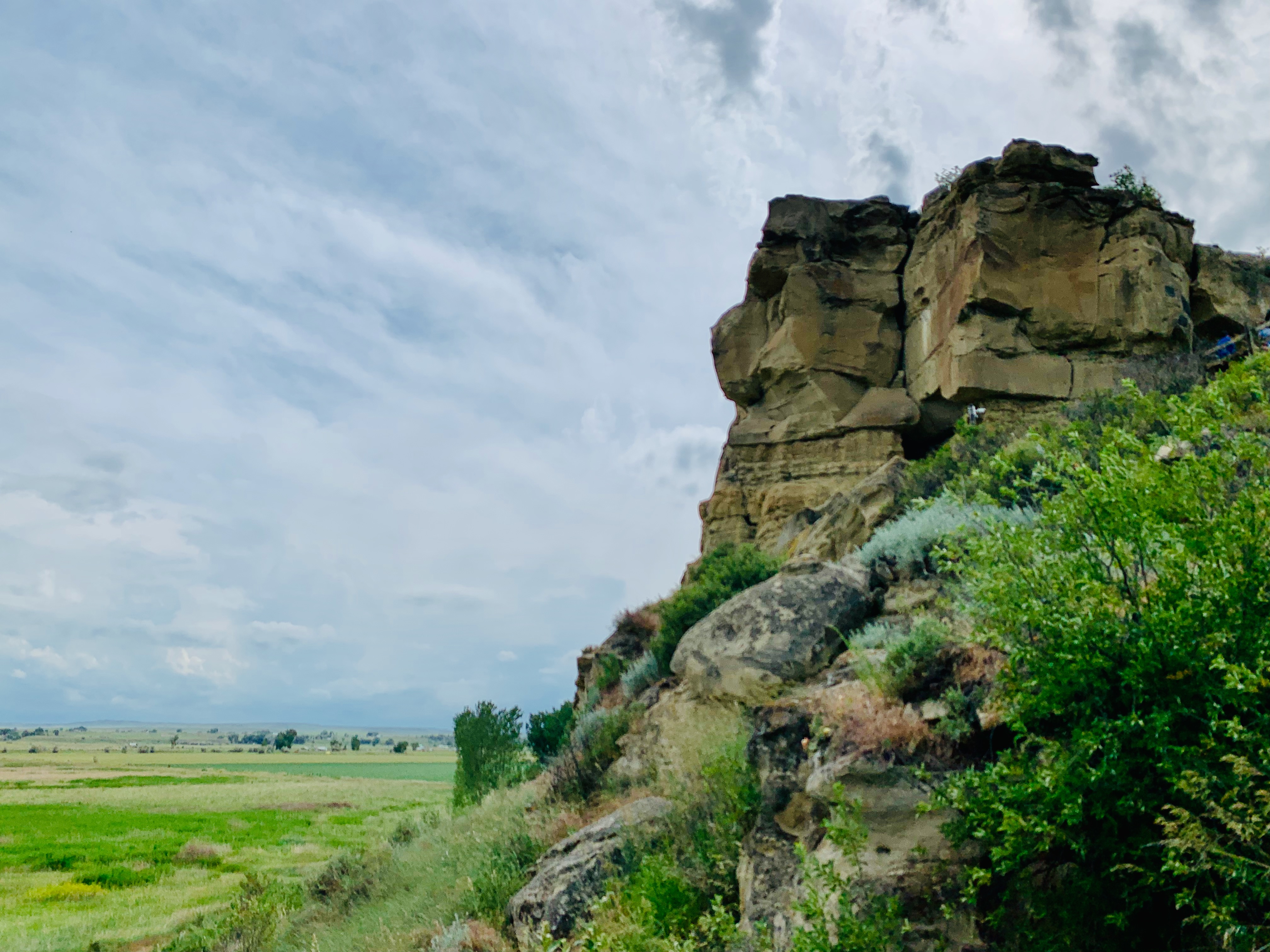 Pompeys Pillar — a lone sandstone outcrop that has been a landmark on this river for as long as people have traveled it
The Rock That Watched the West Go By
Managed by the Bureau of Land Management rather than the Park Service, Pompeys Pillar is the kind of place you could drive right past on your way to somewhere more popular. We left the interstate for it expecting little more than a leg-stretch, and stayed far longer than we planned. The pillar is a single sandstone outcrop rising straight out of the rolling plains of southern Montana's Yellowstone River valley — the kind of landmark you can see from a long way off, which is exactly why it has mattered for so long. For centuries it was a navigational marker, a "you are here" for anyone moving through this country by foot, horse, or river. Native peoples knew it and left their own record on it: the rock carries old inscriptions, markings, and petroglyphs, layers of the American West carved directly into the stone.
The pillar rises about 150 feet above the plain, protected across roughly 51 acres — a National Historic Landmark since 1965, and a National Monument since 2001. Official recognition came decades after the rock had already been a place of rest on their modern routes.
That was the first thing the pillar taught our girls, before we ever found Clark's famous name. People have been stopping here, and marking that they stopped, for a very long time. Standing at the base and looking up at all those layers you feel the humbling truth of a place like this: it has been a meeting point on the map of this country for so long that a single explorer's signature, famous as it is, becomes just one entry in a very old guest book. History here is not one story. It is countless voices, each leaving its own faint whispers upon the same stone.
Those voices go back much further than 1806. The Crow people, whose homeland this is, call the pillar Iishbiiammaache — the Mountain Lion's Lodge — and archaeologists have traced human use of the site back more than 11,000 years, with the Shoshone, Sioux, Cheyenne, Arapaho, Blackfeet, and Salish all leaving their mark here too. Clark's signature gets the fame, but it shares the rock with more than 5,000 other etchings and pictographs. We pointed that number out to the girls, and it changed how they looked at every mark on the stone after that — not just one famous name, but a whole crowded, quiet conversation across thousands of years.
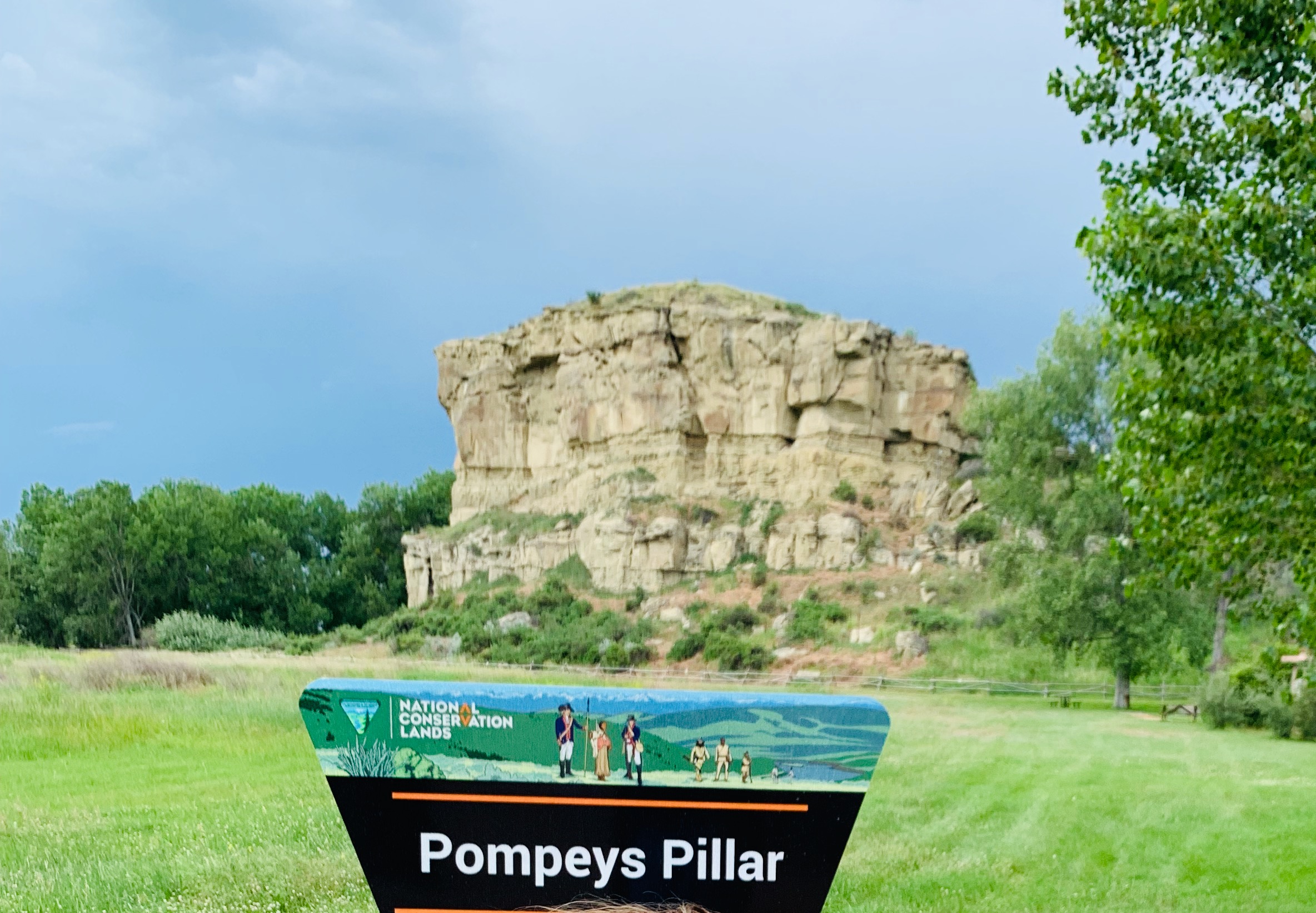 Even the sign at the trailhead tells it as one story, not two — the expedition and the peoples who were already here, together on the same painted landscape
There is a wonderful, easy staircase that carries you right up to the top, which our girls treated as an impromptu playground.
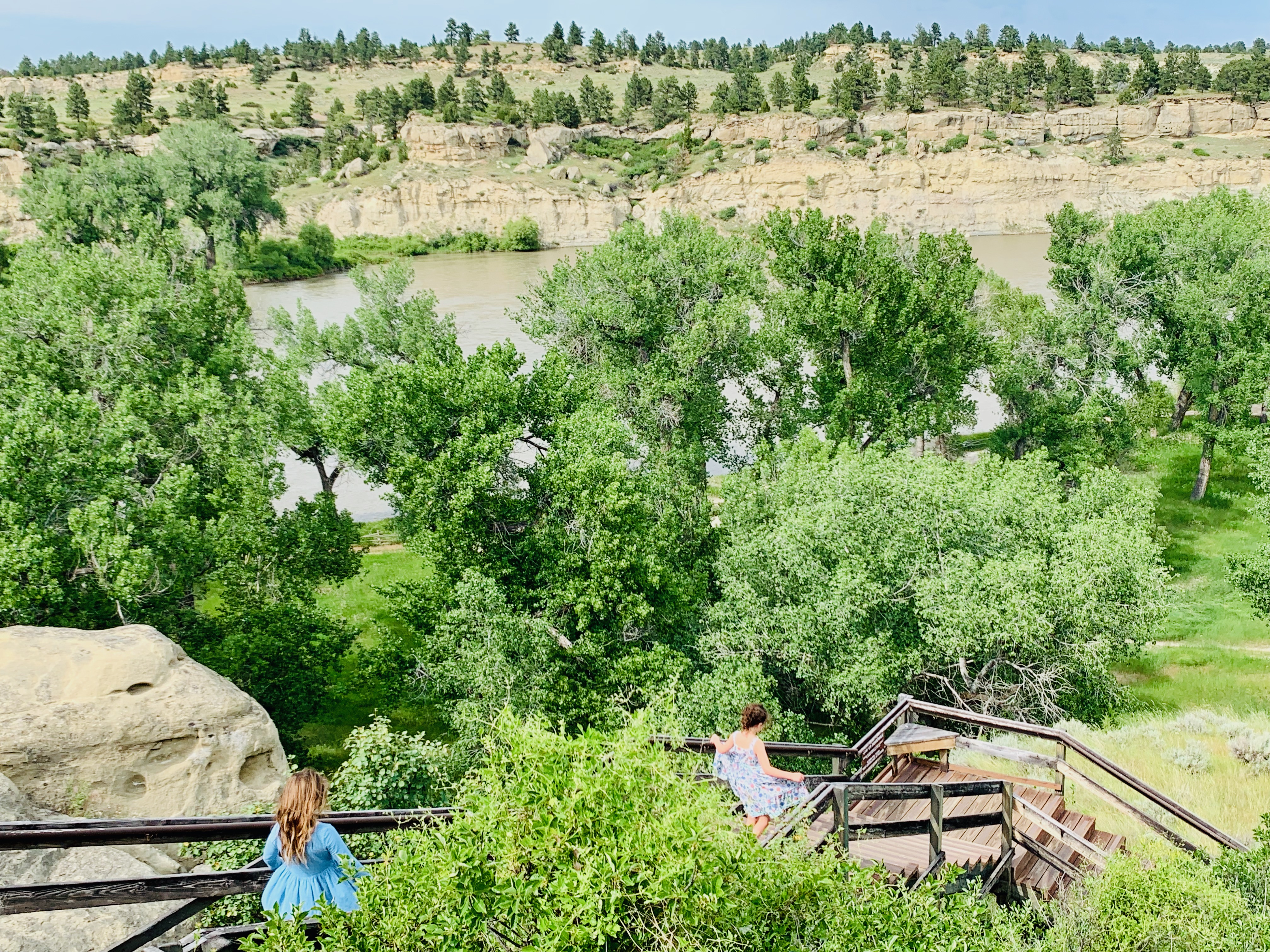 The staircase up — steep enough to feel like a summit to a kid, gentle enough for the whole family
From up there the whole valley opens: the Yellowstone River rolling below, cottonwood forests running along the banks in a green ribbon, and the plains rolling out to the horizon in every direction. It is a big, quiet view, a place of rest.
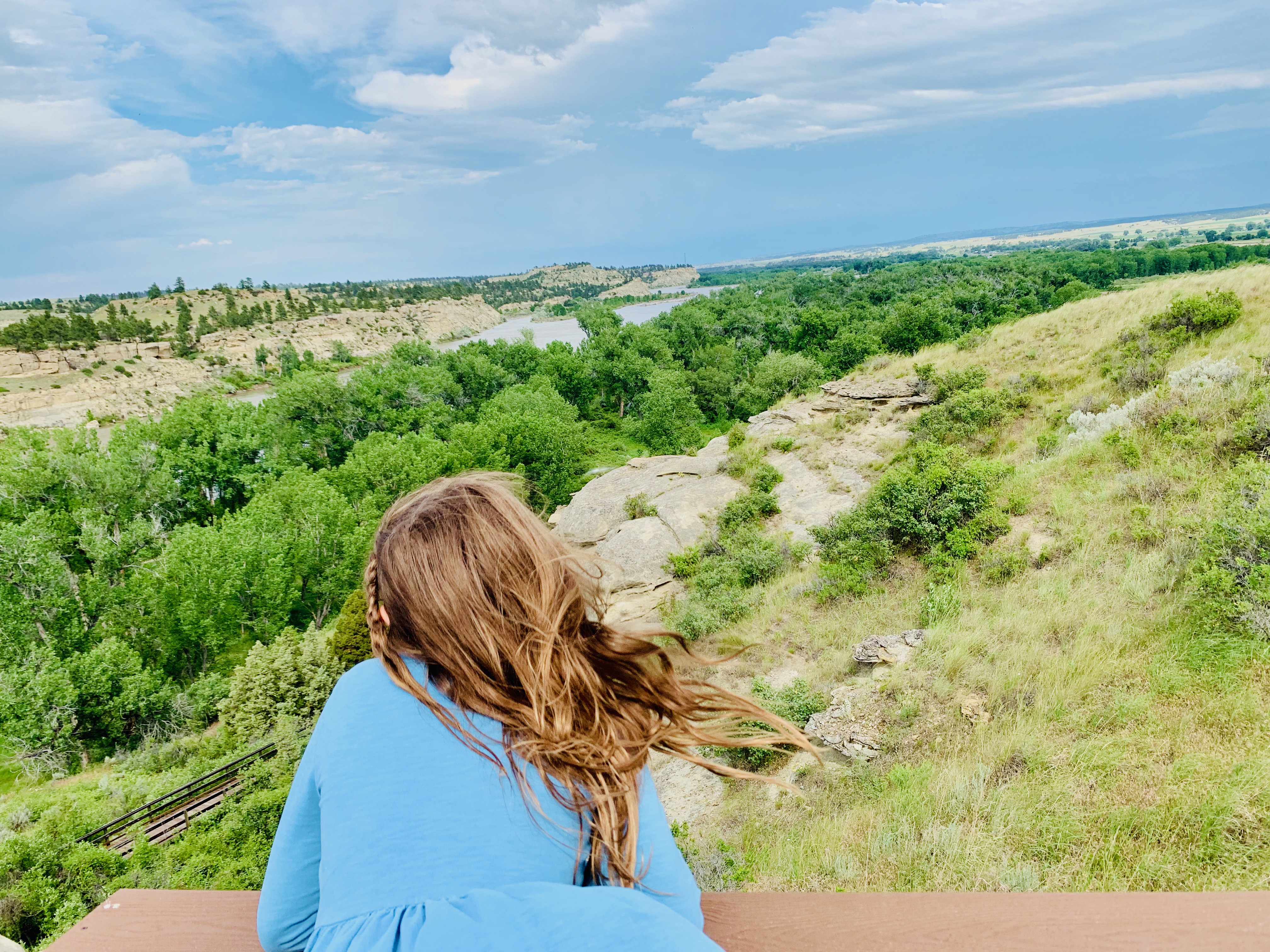 The view from the top — the Yellowstone curling through cottonwood forests, with the plains running to every horizon
A Signature in the Stone
Then you reach the reason everyone comes. Behind protective glass, low on the face of the sandstone pillar, is William Clark's famous inscription. Our girls went quiet in front of it. There is a particular hush that comes over children when history stops being a page in a book and becomes a real thing in front of them. Not a plaque about it. The thing itself.
And the name is its own story. Clark did not name this sandstone outcrop "Clark's Rock." He named the pillar after a little boy — Jean Baptiste Charbonneau, the infant son of Sacagawea, the young Shoshone woman whose knowledge and courage helped carry the expedition across the continent. Clark adored the baby and nicknamed him "Pomp," or "Pompey." He called this landmark Pompey's Tower, and the name, over time became Pompeys Pillar. The girls loved that the most enduring monument to the whole journey is named, in the end, for a toddler.
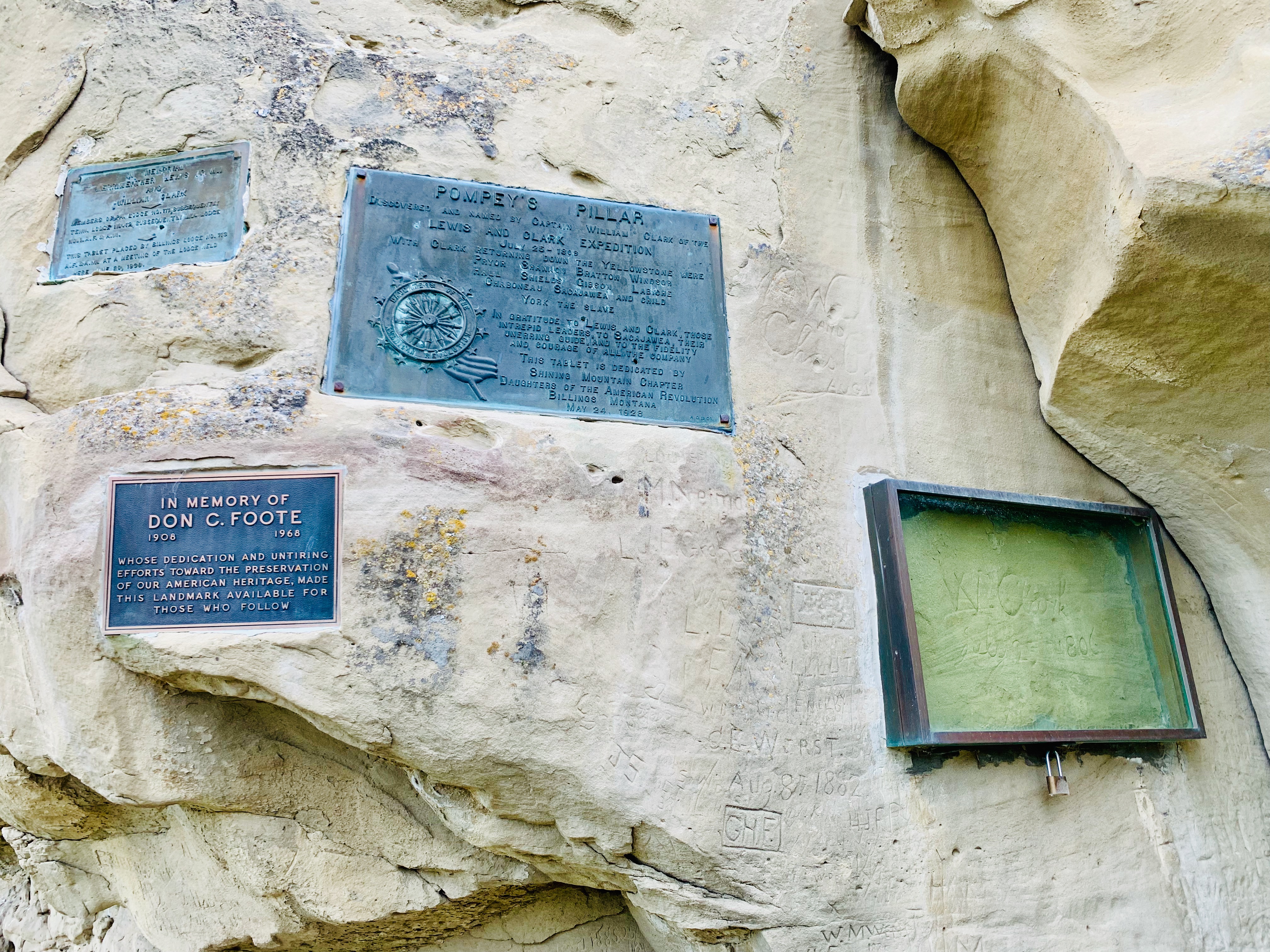 "W. Clark, July 25, 1806" — the only on-site physical evidence of the expedition still visible today
Traveling the Way They Traveled
Down at the base, the site has period-style dugout canoes — the same kind of hand-built craft the expedition used to travel the Yellowstone by water in 1806. Climbing into the canoes made the girls realize the Yellowstone River is really a road, a powerful one with forward momentum, and the trees along it are not a decoration, they are the bones and a repair kit and shelter.
That is the thread the interpretive center pulls all the way through. It tells the story of the people who traveled here before — Native nations, the expedition, all those after — and how the land itself carried every one of them. It is a quiet, honest lesson about depending on a place instead of merely passing through it. They walked out treating the Yellowstone not as a pretty view but as the thing that made the whole story possible.
The Junior Ranger Badge
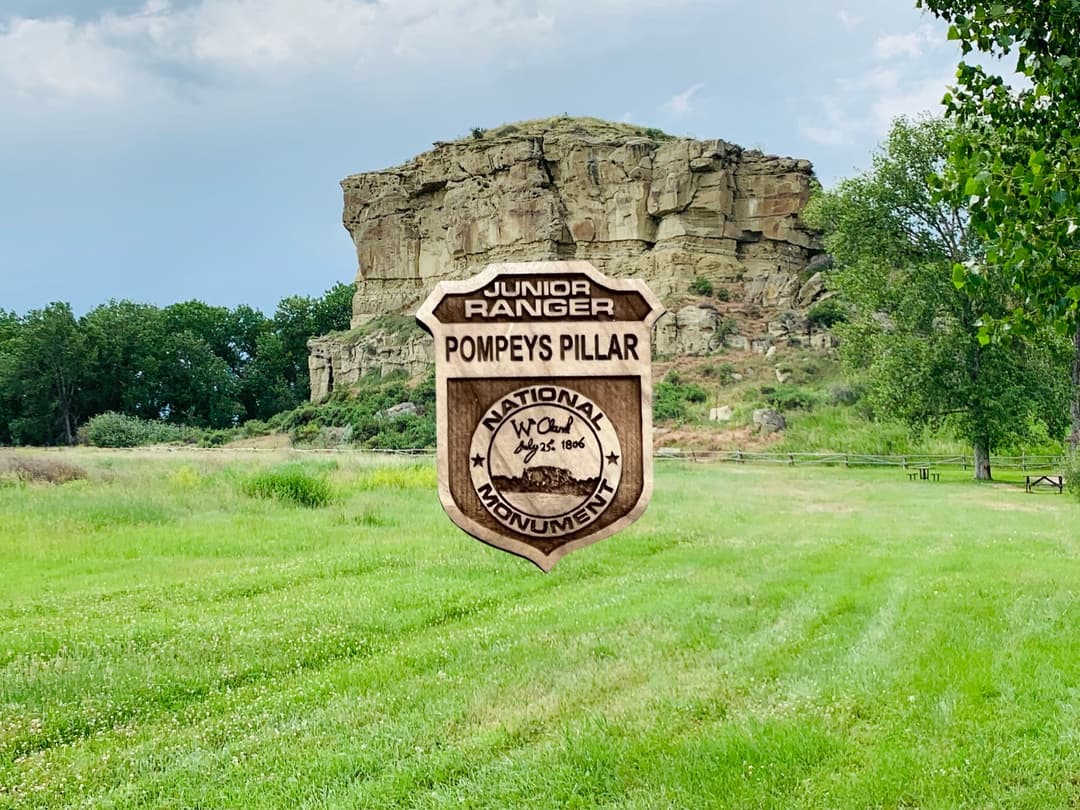
Pompeys Pillar runs a Junior Ranger program, and the badge is one of the more meaningful ones in our collection: at its center is Clark's own signature, W. Clark and the 1806 date. It's shaped like a ranger's shield with the pillar's own silhouette behind the medallion — small enough to pin on a backpack, but it's the one our girls point to first when they show off the collection. A badge that hands a kid the marquee artifact of the place, rather than a generic emblem, tells you the people who run this site know how to imprint memories.
What stayed with the girls was not a fact to memorize but a feeling: that one person, on one ordinary July afternoon, reached out and left a mark that would still be here to meet them two centuries later — and that the land had kept it safe the whole time. A moment where you are a part of it, and truly understand that you are one more traveler in a very long line, entrusted with keeping the story alive for whoever comes down the river next.
Van Life Tips for Pompeys Pillar
Make it a stop, not a detour. Pompeys Pillar sits 25 miles east of Billings, off I-94 exit 23, and you can experience it fully in an hour or two — the staircase, the signature, the boats, the interpretive center. It is a perfect leg-stretch with real substance on a long Montana drive, and the paved lot has room for RVs. Entrance is $7 a vehicle, and an America the Beautiful pass gets you in free — walk-in access is free year-round even outside gate hours.
Where to stay: This is a day-use site — there is no camping at the pillar itself. Billings, Montana's largest city, is the natural base, with full services and campgrounds, and it makes an easy launch point for the visit. Top off water and fuel there before you head out.
Best time to visit: The site runs seasonally, open May 1 through October 1, gates 8am to 4pm daily except Tuesdays, when it's closed for maintenance. Summer mornings are lovely here, before the open sandstone soaks up the afternoon heat.
What to bring: Sun protection and water, always — the pillar is exposed and Montana summer sun is no joke. Binoculars reward you at the top, where the river and cottonwoods run for miles. And curiosity: read a little of the Lewis and Clark story with the kids before you arrive, and that signature behind the glass will hit ten times harder.
Where We Headed Next
Some stops are famous for their scenery. This one is famous for a single square foot of rock — and it may be the most moving hour we have spent on any of these drives. There is something about standing where the map of the American West was still being drawn, in front of proof that a real person stood there too, that reorders how a kid sees the whole country.
We rolled out the way this place sends you out: quieter, and a little more careful with things that last. If you are piecing together how a family of ours makes these history-rich detours part of ordinary life on the road, that is a story in itself — Affordable, Easy and Fun Family Vacations at our National Parks. The trail, like the river below the pillar, just keeps going.
Parks Mentioned in This Post
Earn Junior Ranger badges at these parks — track your progress on our badge tracker
Continue the Journey
More in National Parks & Places
Jul 4, 2026
Jun 28, 2026