
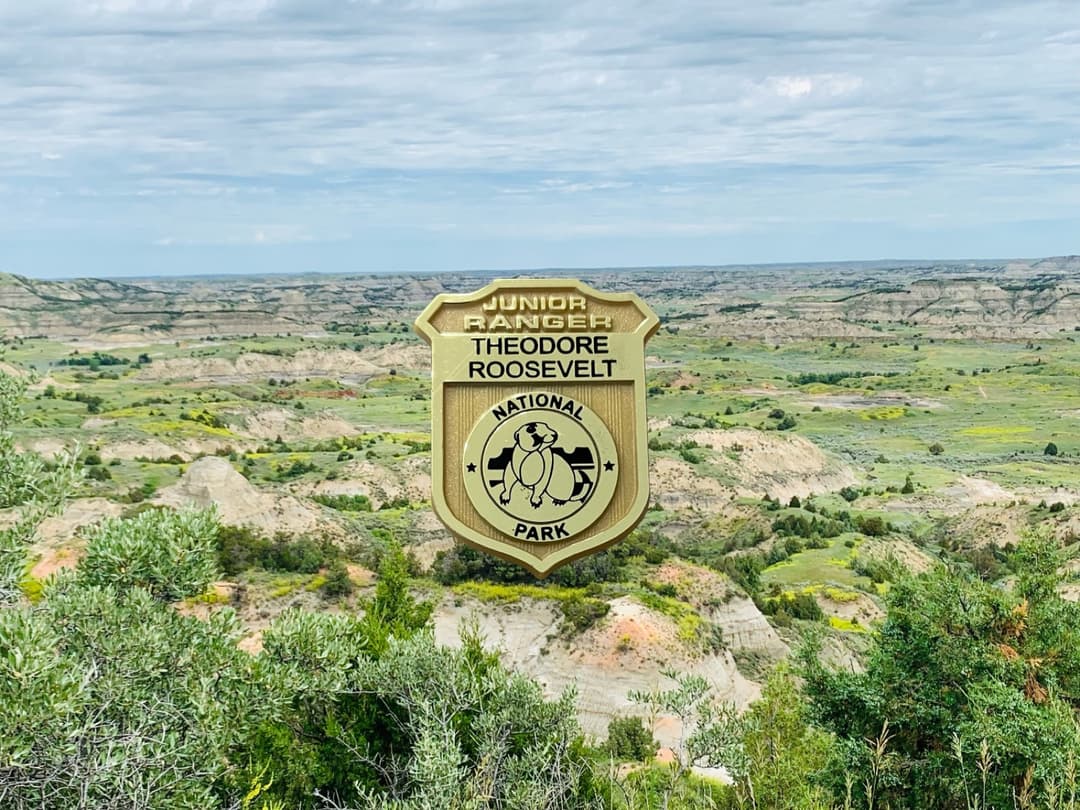
Theodore Roosevelt with Kids: Junior Ranger Guide
Theodore Roosevelt National Park honors our nation's greatest early conservationist in a fitting way – it is the only national park in the United States named for a single person. The windswept North Dakota badlands it protects are the very landscape that shaped the young rancher who would become our 26th President and the man many consider the Father of our National Parks. Through his conservation vision, Theodore Roosevelt vastly expanded America's public lands, protecting 230 million acres during his presidency – more than any other president in U.S. history.
To be fair, other National Park Service sites are named in honor of remarkable individuals, but they are memorials, monuments or historic sites that preserve their lives and legacies. Theodore Roosevelt National Park stands alone in being the National Park named after the conservationist whose efforts helped define the very idea of protecting America's wild places – and is rightly placed on the landscape that made the person.
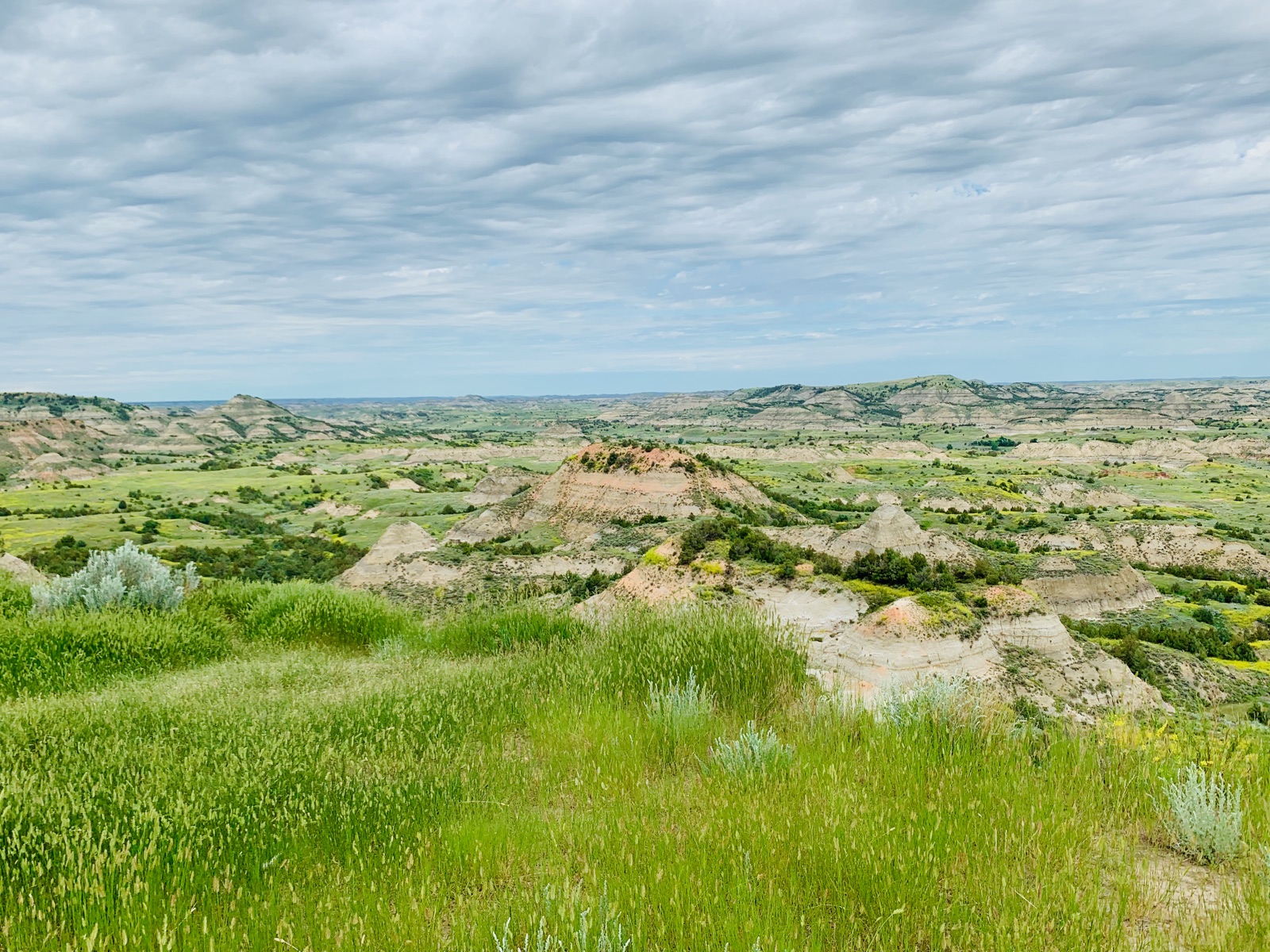 The mixedgrass prairie meets the badlands — wind-shaped, drought-adapted, and glowing green in the summer sun
The Windswept Badlands
We drove into it off the busy North Dakota highway, and the first thing the badlands gave us was the thing they are least famous for: stillness. One minute you are in the hum of trucks and travel plazas, and the next the land opens up and drops away into painted layers of rock and green, and the wind takes over the conversation. It was meant to be a quick stop on our long swing through the parks of the Upper Midwest. It became one of the stops we still talk about.
The badlands here are not the bare, lunar kind. In the heat of a North Dakota summer they are an expanse of green and gold — banded buttes rising out of a sea of grass, with yellow flowers scattered absolutely everywhere. Prairie sunflowers. Yellow sweetclover. Goldenrods. The mixedgrass prairie is wind-shaped and drought-adapted, shelter for birds and wildlife, and it moves like water. You do not so much look at this landscape as watch it paint its own canvas.
The girls stood at the overlook rail for a long time, which, if you have traveled with children, you know is its own kind of miracle. There is something about a view with no edges. No single famous feature to check off, just layered color running all the way to the horizon.
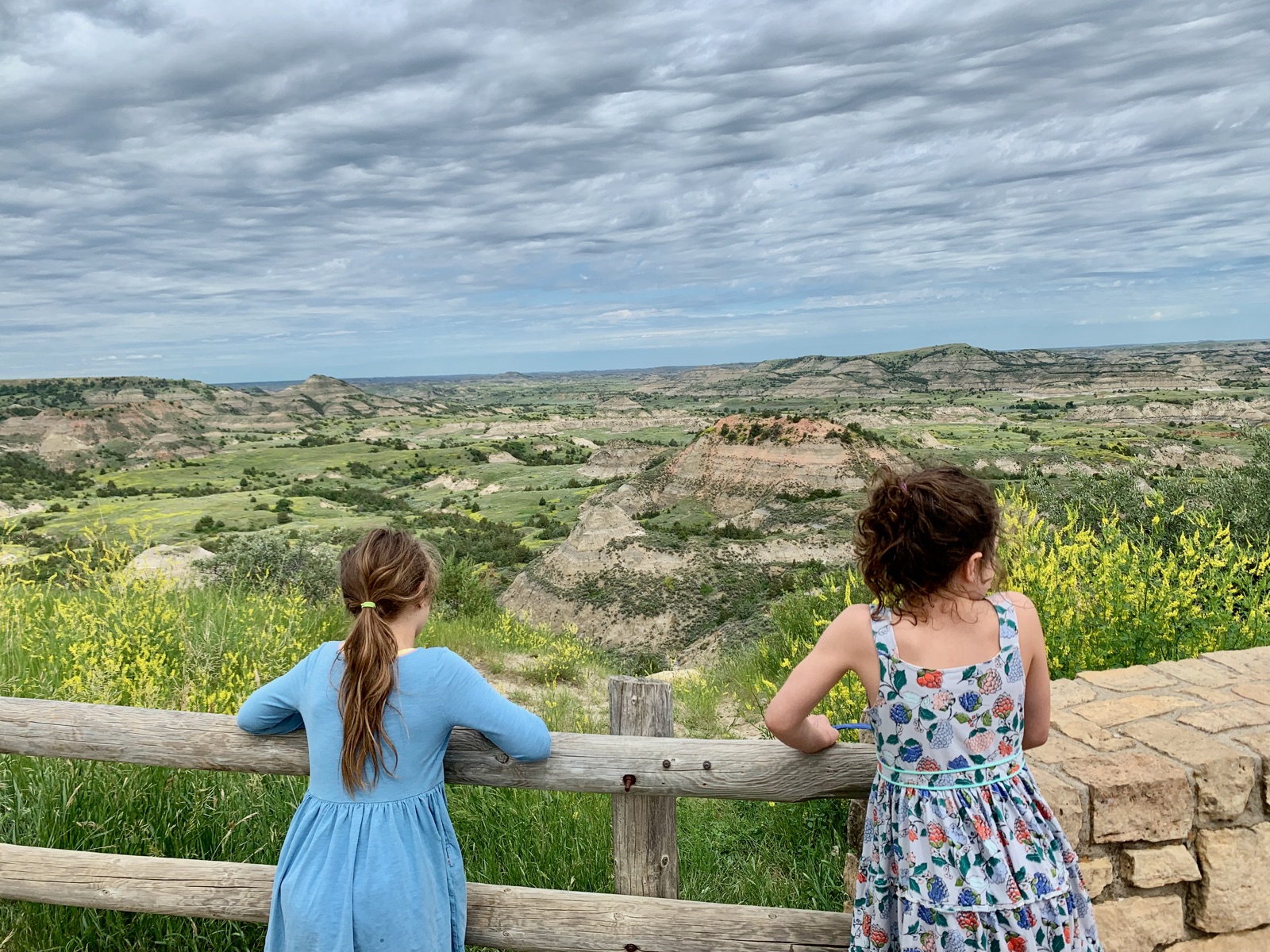 Taking in the badlands — a view with no edges
It is a step into peace and stillness, and it does not ask anything of you except that you be part of it.
Where the Buffalo Are Not Buffalo
Theodore Roosevelt is where our girls learned that buffalo are not actually buffalo. They are bison — tatanka to the Lakota, who knew them best. North America does not have a true buffalo at all; Asia and Africa do. Somewhere along the way the wrong name stuck, and nearly all of us grew up saying it.
For the girls, that landed bigger than a wildlife fact. It was the day they realized that sometimes a thing everyone knows is simply a widely held mistake — that you can love something, name it, sing songs about it, and still have to question how it is defined. If a park can teach a kid that, the entrance was worth it before you even reach the first trailhead.
And this is one of the best places anywhere to see and hear the wild plains: bison herds stampeding, wild horses galloping, prairie dogs barking their alarms across the prairie-dog towns, coyotes and raptors prowling, songbirds fluting from the tall grass. We watched a mountain bluebird — impossibly blue, the exact color the sky was trying to be — perch on a dried stalk at the rim of an overlook, content.
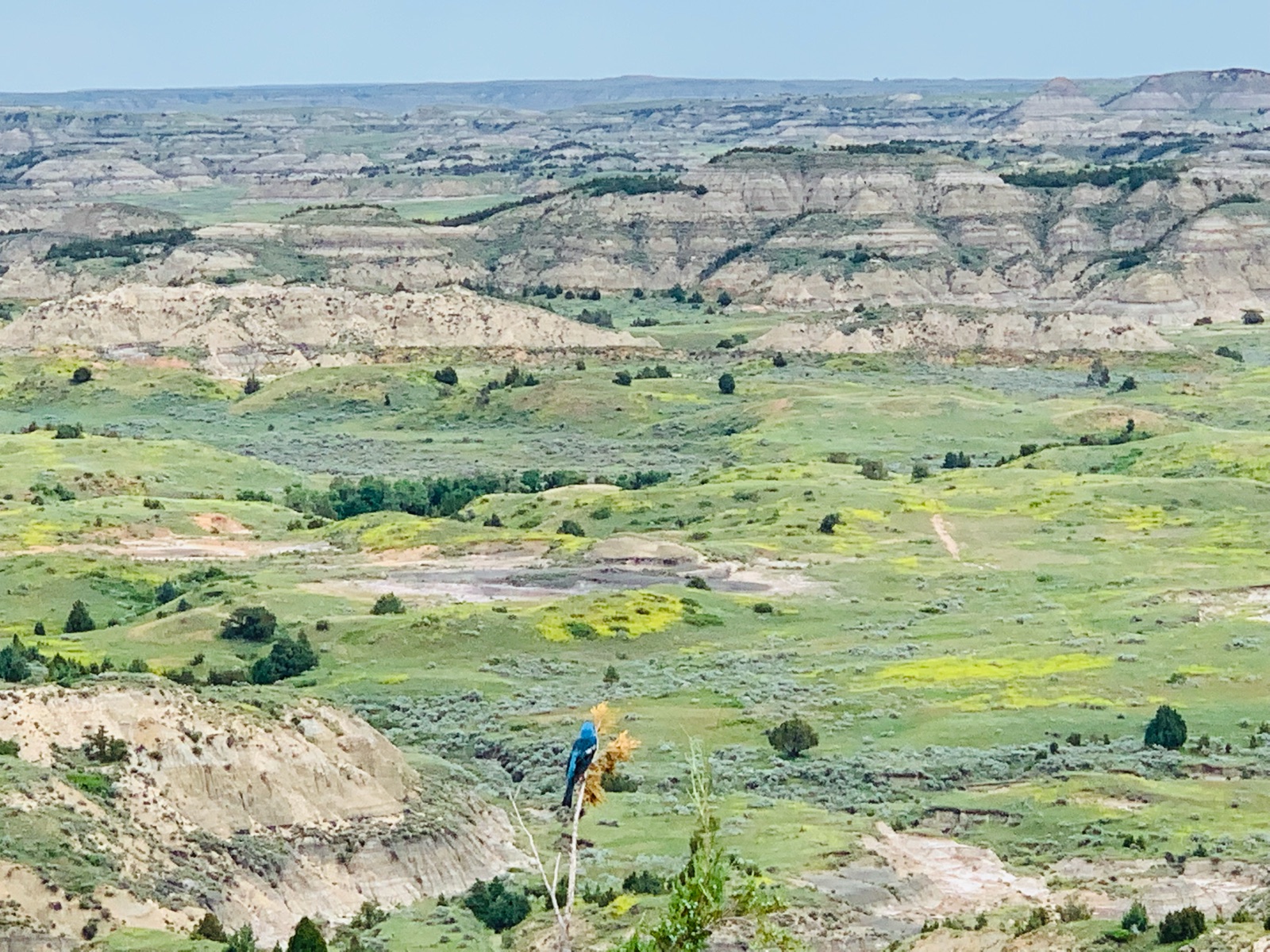 A mountain bluebird holding the foreground against several thousand acres of badlands
The President the Badlands Made
Who would have guessed that Theodore Roosevelt was not only a naturalist, conservationist, and a great president, but a working rancher out on this remote prairie? He came here young and grieving, having lost his wife and his mother on the same day. The North Dakota badlands did for him what wild places have long offered to those searching for renewal – space to heal, hardship to overcome, and a rediscovery of meaning and purpose. Roosevelt credited this land with shaping him for the rest of his life.
I never would have been President if it had not been for my experiences in North Dakota. — Theodore Roosevelt
What he did with that gratitude is the part that gives me chills every time we stand in a wild place with our daughters: he paid it forward to all of us. As President he helped establish the foundation of the national park and national forest systems, protecting hundreds of millions of acres of public land for future generations. Every trailhead our family has ever stood at owes something to what this stretch of North Dakota did to one man's heart.
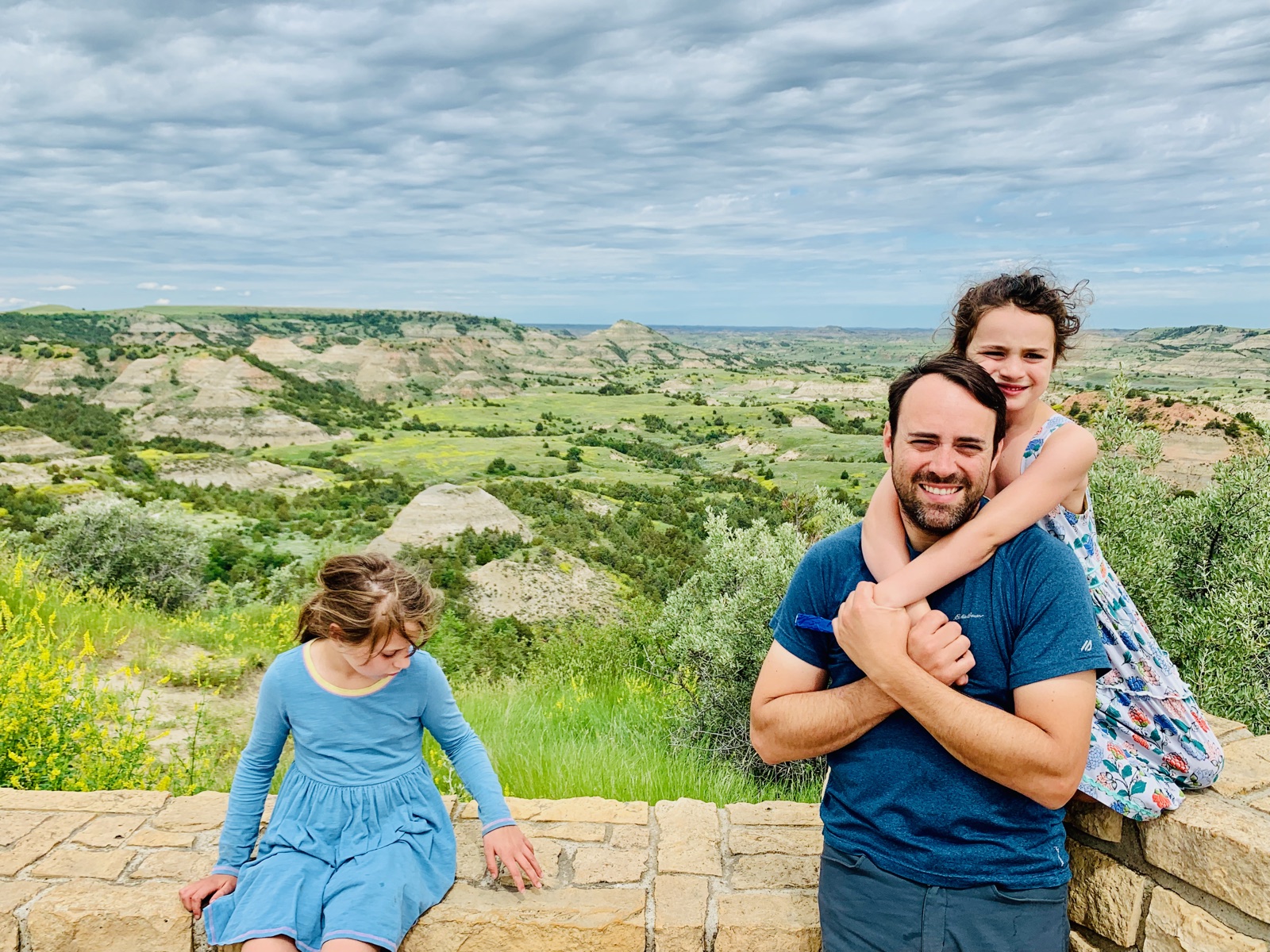 Sprinterdad and the girls at the overlook wall — sweetclover and badlands in every direction
That is the magic of a park like this one: it's not just a history lesson, but a reminder that the places we love are gifts entrusted to us, to pay it forward, by protecting them for those who come after us.
The Junior Ranger Badge
The rangers here are wonderful — genuinely helpful, with great programming built to teach children about the nature of the badlands and the legacy of the man the park is named for, deeply tied to his love of the American landscape. The Junior Ranger badge itself is one of our favorites in the collection: it carries a prairie dog front and center, which tells you the park knows exactly who its most charismatic residents are.
The girls worked through the badge activities with imaginings of bison herds stampeding across the prairie. What stayed with them was this, and what one person's love of wild country can turn into. Not a plaque. Not a statue. A living, breathing, barking, stampeding stretch of protected earth — handed forward to children who haven't been born yet, so they can imagine the same.
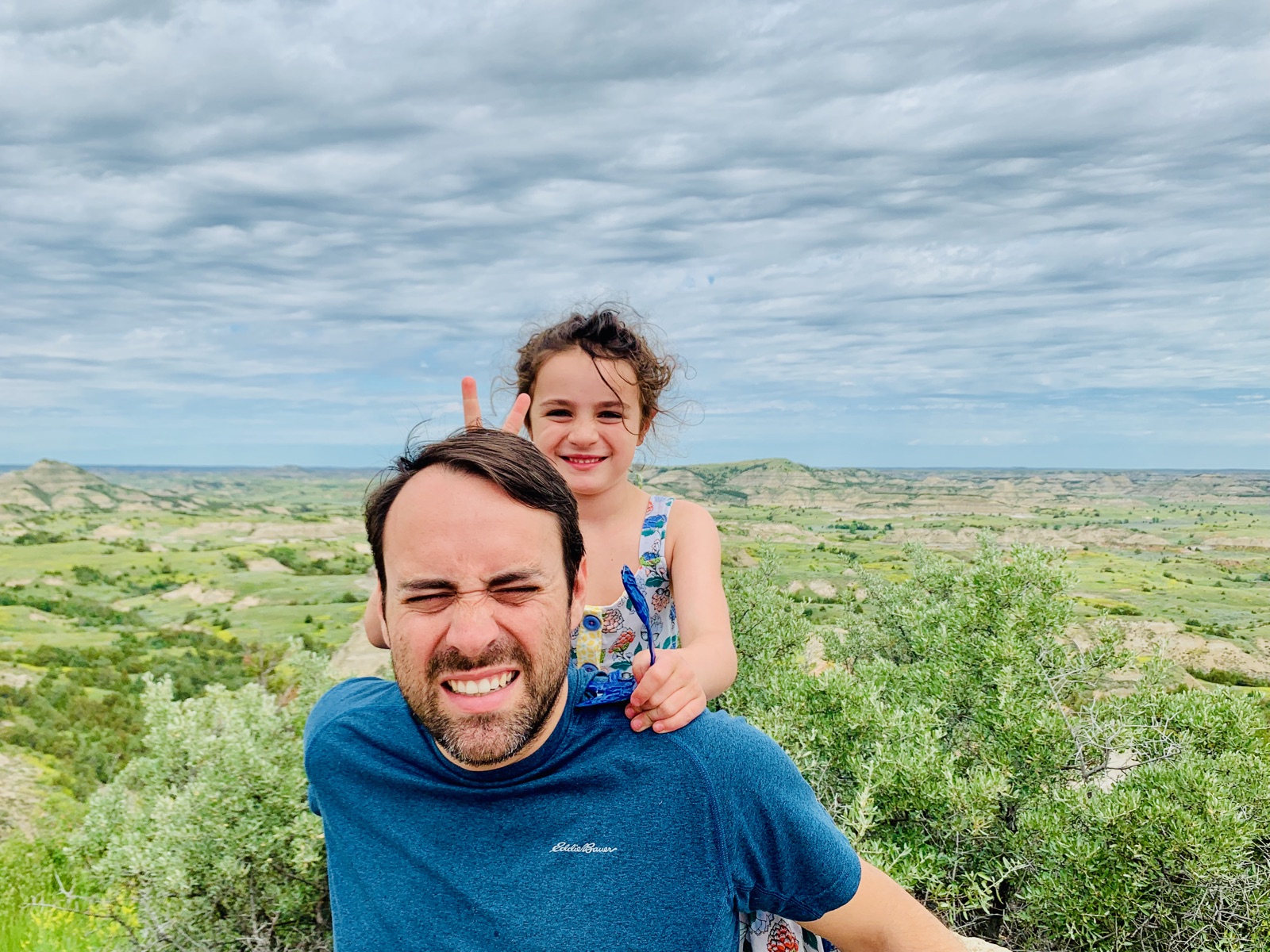 Bunny ears at the overlook — reverence and goofiness travel together in this family
And because we are us, the sacred and the silly shared the same overlook. Bunny ears above the badlands. Roosevelt, who filled the White House with children and ponies and once a badger, would have approved.
Van Life Tips for Theodore Roosevelt
Even a quick stop is worth it. This park sits right along the interstate corridor, and you can meet the badlands in an afternoon — overlooks, prairie-dog towns, wildlife on the move. Ours was a short visit that punched far above its weight. But it left us with a "we'll be back" feeling, so budget more time than we did if you can.
Where to stay: The park's Cottonwood Campground sits down among the cottonwoods near the Little Missouri River and is a favorite with vanlifers; there is no hookup camping inside the park, so top off water before you come in. The gateway town of Medora has full-service options if you need them.
Best time to visit: Early-to-mid summer, when the prairie is green, the sweetclover and sunflowers are blooming, and the wildlife is out with their young. Bring patience for bison traffic jams — they have the right of way and they know it.
What to bring: Binoculars, absolutely — the wildlife here performs at every distance. Sun protection and water, because the prairie offers big sky and little shade. And a windbreaker, even in July. This is windswept country; that is half its personality.
Where We Headed Next
Theodore Roosevelt was the closing chapter of our big swing through the sacred country of the Upper Midwest — the same journey that took us into the breathing earth at Wind Cave with Kids: Junior Ranger Guide, and that we gathered up whole in Magic in the National Parks: Upper Midwest. After this stop, the swing was complete, and we rolled out the way Roosevelt country sends everyone home: quieter, dustier, and already planning the return.
The return has a funny way of happening, too. Years later and half a continent away, we found ourselves on Theodore Roosevelt Island, his living memorial in the middle of the Potomac — a world apart from these North Dakota plains, and somehow the exact same man. His legacy keeps meeting us wherever we take the girls into the wild. We suspect it always will.
Wondering how we make these trips happen with the whole family? Read Affordable, Easy and Fun Family Vacations at our National Parks.
Parks Mentioned in This Post
Earn Junior Ranger badges at these parks — track your progress on our badge tracker
Continue the Journey
Wind Cave with Kids: Junior Ranger Guide
Wind Cave National Park holds about 95% of the world's known boxwork — and it is a cave that breathes, exhaling and inhaling through its one natural entrance as the pressure changes. To the Lakota it is Maka Oniye, the breathing earth, the door their people came through...
Magic in the National Parks: Living Legends of the Charming Upper Midwest
Pipestone National Monument is the only place in the U.S. where catlinite — the sacred red stone of Indigenous ceremonial pipes — is still quarried, a right reserved exclusively for Native people. Here's our journey through the Upper Midwest's living legends.
More in National Parks & Places
Jul 14, 2026
Jul 4, 2026
Jun 28, 2026